Why Weight Training Is One of the Best Things Women Can Do for Their Health
For years, women were told that the key to being healthy was endless cardio, eating less, and trying to make themselves smaller. But the truth is, one of the most powerful things women can do for their long-term health, hormones, metabolism, and confidence is build muscle.
Weight training is not just about aesthetics. It is about creating a stronger, healthier, more resilient body that supports you through every stage of life.
And for women dealing with insulin resistance or PCOS, strength training can be especially life-changing.
Muscle Helps Improve Insulin Resistance
One of the biggest reasons weight training matters for women with insulin resistance or PCOS is because muscle acts almost like a sponge for glucose.
When we build and maintain muscle mass, our bodies become more efficient at using insulin and pulling glucose into the muscles for energy. This helps improve insulin sensitivity and can reduce the amount of insulin circulating in the body.
For women with insulin resistance, this is huge.
High insulin levels can contribute to:
Weight gain or difficulty losing weight
Increased cravings and hunger
Fatigue
Hormonal imbalances
Inflammation
PCOS symptoms
Building muscle gives your body a better place to “store” and use glucose instead of allowing excess sugar to remain circulating in the bloodstream.
This is one of the reasons many women notice improvements in:
Energy levels
Body composition
A1C and blood sugar markers
Cravings
Hormonal symptoms
Overall metabolism
…when they begin strength training consistently.
Muscle Helps Support Your Metabolism
Another major benefit of weight training is metabolic health.
Muscle tissue requires more energy than fat tissue, even at rest. That means the more muscle you have, the more calories your body naturally burns throughout the day.
This does not mean women need to become bodybuilders or spend hours in the gym.
It simply means that building lean muscle helps support a healthier, more efficient metabolism over time.
For many women, especially those struggling with hormonal imbalances, under-eating and overdoing cardio can actually slow metabolism down and increase stress on the body.
Strength training helps create a healthier foundation.
Instead of constantly trying to “burn off” food, we focus on:
Supporting muscle growth
Fueling the body properly
Improving metabolic function
Creating long-term sustainability
Weight Training Helps Women Age Stronger
One of the most overlooked benefits of strength training is how much it helps us as we age.
As women get older, we naturally begin to lose muscle mass and bone density if we are not actively maintaining them. This can increase the risk of:
Weakness
Falls and injuries
Osteoporosis
Joint pain
Reduced mobility
Loss of independence later in life
Strength training helps combat this.
When done with proper form and guidance, resistance training helps:
Improve bone density
Strengthen joints and connective tissue
Improve balance and stability
Support posture
Protect the body from injury
Building strength now is an investment in your future self.
Functional Strength Matters in Everyday Life
One of my favorite things about weight training is that it directly translates into everyday life.
So many exercises we do in the gym mimic movements we use outside of it.
For example:
Deadlifts teach us how to safely pick heavy items up off the floor — whether that is groceries, laundry baskets, or our children.
Squats help us sit down and stand up more comfortably and safely.
Rows and upper body pulling exercises help improve posture and make carrying bags, lifting boxes, or pulling objects easier.
Core training helps support the spine and improve balance and stability.
Glute and hip strengthening exercises help support the knees, hips, and lower back.
Strength training is not just about looking strong.
It helps us live stronger.
You Will Not “Bulk Up”
This is one of the biggest fears many women have when starting strength training.
The reality is that most women do not naturally have the hormone levels required to “bulk” quickly from lifting weights.
Instead, what most women experience is:
More muscle tone
Better posture
Improved confidence
Increased strength
Better body composition
More energy
Strength training helps shape and support the body — not ruin femininity.
In fact, many women feel more confident, empowered, and connected to their bodies once they begin training.
Strength Training Is About More Than Appearance
At the end of the day, weight training is not punishment.
It is a tool for building a healthier, stronger life.
It is about:
Supporting your hormones
Helping your metabolism function better
Improving insulin sensitivity
Protecting bone health
Increasing confidence
Supporting longevity
Feeling capable in your body
Your body deserves support, nourishment, and strength — not endless restriction.
And no matter your age or fitness level, it is never too late to start building strength.
Why Eating Too Little Can Make Insulin Resistance Worse-And how nourishing your body properly can help heal your metabolism
If you’ve been struggling with insulin resistance, PCOS, stubborn weight gain, energy crashes, or migraines, chances are you’ve been told some version of this advice:
“Just eat less.”
For years, I thought that was the answer too.
I worked out consistently. I ate what most people would consider “healthy.” I tried to be disciplined. But despite all of that, my body still felt off. I was exhausted, inflamed, constantly hungry, struggling with weight gain that didn’t make sense, and dealing with migraines that affected my daily life.
Eventually, I discovered I was dealing with insulin resistance and low-grade PCOS — and it completely changed the way I viewed nutrition.
One of the biggest things I learned?
Undereating can actually make insulin resistance worse.
Your Body Needs Fuel to Function Properly
A lot of women with insulin resistance fall into a cycle of:
Restricting calories
Skipping meals
Under-eating protein
Overdoing cardio
Constantly trying to “burn off” food
But when we chronically underfuel ourselves, our bodies begin to perceive stress and scarcity.
That can lead to:
Increased cortisol (stress hormone)
Muscle loss
Slower metabolism
More blood sugar instability
Increased cravings and binge cycles
Poor energy production
Greater insulin resistance over time
Our cells become less efficient, not more.
Insulin Resistance Is About More Than Sugar
Insulin is a hormone that helps move glucose (sugar) from your bloodstream into your cells where it can be used for energy.
When your cells become resistant to insulin, your body has to produce more and more insulin to get the same job done.
Over time, this can contribute to:
Fatigue
Weight gain
Brain fog
Hormonal imbalance
PCOS symptoms
Inflammation
Cravings
Headaches and migraines
One of the best ways to improve insulin sensitivity is by supporting the body properly — not starving it.
Why Protein and Muscle Matter So Much
Muscle is incredibly important for insulin sensitivity.
The more lean muscle mass we have, the better our bodies are at utilizing glucose efficiently. Muscle essentially acts like a sponge for glucose, helping improve blood sugar regulation and metabolic health.
This is one reason why strength training and adequate protein intake can be so powerful for women with insulin resistance.
Instead of focusing only on eating less, we should also focus on:
Eating enough protein
Building muscle
Balancing meals
Supporting blood sugar stability
Nourishing our bodies consistently
Protein also helps:
Keep us fuller longer
Stabilize energy
Reduce cravings
Support hormone production
Improve recovery and metabolism
Don’t Forget Micronutrients
Macronutrients (protein, fats, and carbohydrates) matter — but micronutrients matter too.
When we overly restrict food, we often miss out on important vitamins and minerals that support:
Hormone health
Blood sugar regulation
Nervous system function
Energy production
Recovery and inflammation
Foods rich in nutrients like magnesium, potassium, omega-3s, B vitamins, and antioxidants can make a huge difference in how we feel day to day.
My Experience with Lower Carb Eating
One thing that has personally helped me tremendously has been lowering my carbohydrate intake — not in an extreme, fear-based way, but in a balanced and intentional way.
I noticed improvements in:
My A1C levels
My fasting insulin levels
Energy stability
Hunger cues
Migraine frequency
For me, lowering carbs while prioritizing protein, healthy fats, fiber, and nutrient-dense foods helped my body feel calmer and more regulated.
And importantly:
I still eat enough.
That part matters.
Low carb does not have to mean starving yourself. It can simply mean being more intentional about choosing foods that help your blood sugar stay stable and your body feel nourished.
Focus on Supporting Your Body — Not Punishing It
Healing insulin resistance isn’t about perfection.
It’s about learning how to work with your body instead of constantly fighting against it.
Sometimes that means:
Eating more consistently
Prioritizing protein
Strength training
Managing stress
Sleeping better
Choosing lower glycemic foods
Nourishing your body instead of depriving it
Your body is not broken. It’s asking for support.
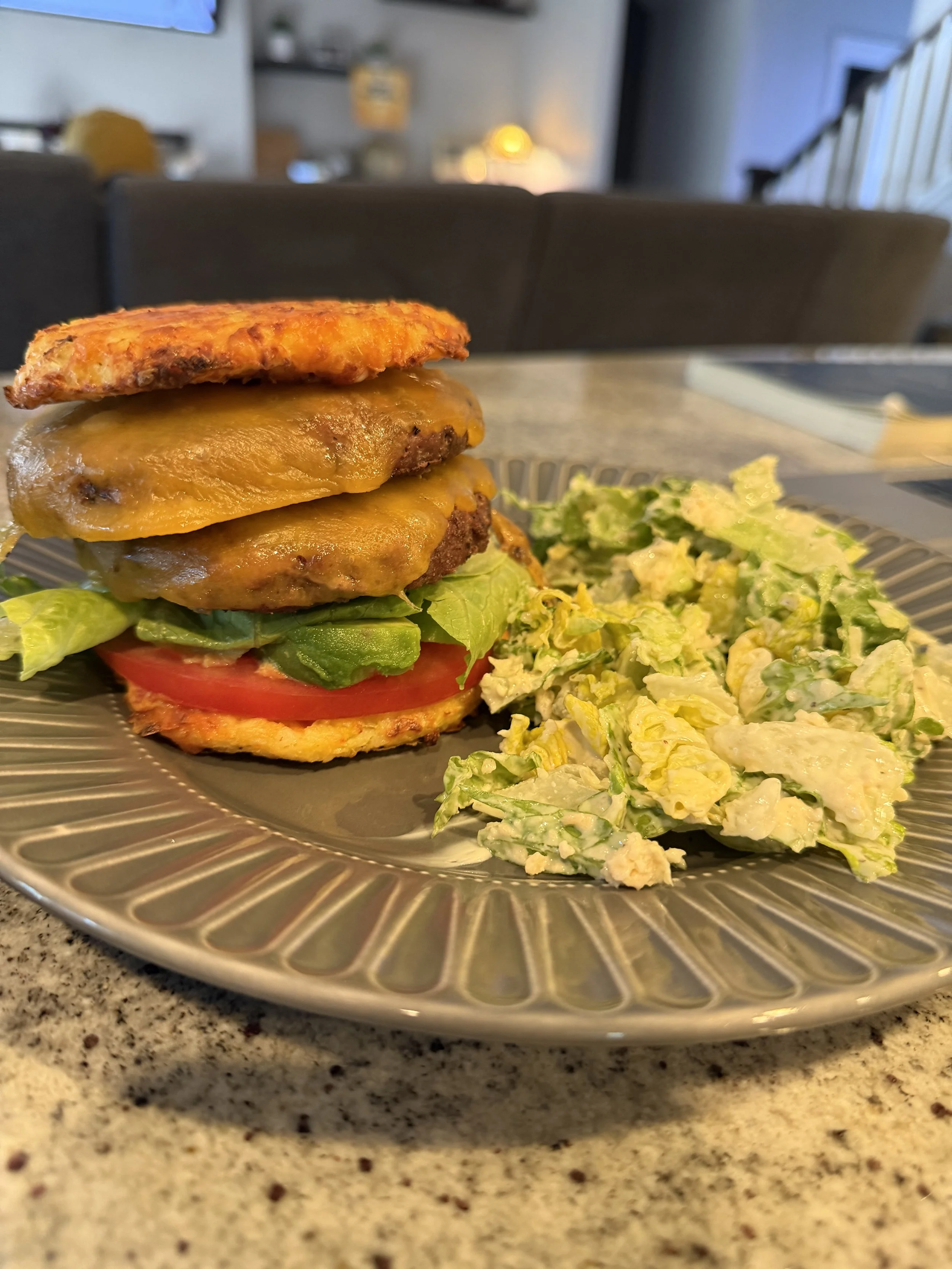
Low Carb Cauliflower Cheddar “Buns” or Taco Shells
These are one of my favorite low carb alternatives for buns, wraps, or taco shells. They’re cheesy, crispy, filling, and surprisingly versatile!
Ingredients
2 cups cauliflower florets
1 egg or 2 egg whites
1/2 tsp garlic powder
1/4 tsp salt
2 1/4 cups cheddar cheese
Instructions
Preheat oven to 400°F.
Line two baking sheets with parchment paper.
Add cauliflower florets to a food processor and pulse until finely grated with no large pieces remaining.
Add the remaining ingredients and pulse until fully combined.
Scoop about 3 tablespoons of mixture onto the baking sheet.
Flatten into thin, round circles (about 1/8–1/4 inch thick depending on preference).
Repeat with remaining mixture.
Bake for 15–20 minutes until golden brown, flipping halfway through.
These work great for:
Burgers
Sandwiches
Taco shells
Breakfast wraps
Pizza-style flatbreads
If you try them, tag me — I love seeing your creations 🤍
Final Thoughts
If you’re struggling with insulin resistance, please know this:
You do not need to earn your food.
You do not need to starve yourself to heal your metabolism.
And you are not failing if extreme restriction isn’t working.
Sometimes the answer is actually learning how to nourish your body better — with enough protein, enough nutrients, enough support, and enough consistency to allow your body to finally feel safe again.

Why I Stopped Undereating and Started Building Strength Instead
It All Begins Here
For a long time, I thought eating less was the answer.
Like so many women, I believed that if I just worked out harder, ate less, and stayed “disciplined,” my body would eventually look and feel the way I wanted it to.
But instead, I felt exhausted.
Despite working out consistently and trying to eat “healthy,” I found myself struggling with low energy, weight gain that didn’t make sense, constant frustration, and feeling disconnected from my body. The harder I pushed, the worse I felt.
Eventually, I discovered I was dealing with insulin resistance and low-grade PCOS.
And honestly? That changed everything.
The Problem With Constant Restriction
For years, women have been taught that smaller portions, more cardio, and eating as little as possible are the keys to health and weight loss.
But for many women — especially those dealing with hormone imbalances, stress, insulin resistance, or PCOS — chronic under-eating can actually work against your body instead of with it.
When we consistently under-fuel ourselves:
our energy drops
recovery suffers
cravings increase
workouts become harder
muscle becomes difficult to build
stress levels rise
and our bodies often hold onto fat instead of letting it go
Our bodies are designed to protect us.
And when they feel unsupported, they respond accordingly.
What Changed For Me
Instead of focusing on eating less, I started focusing on:
eating enough protein
strength training intentionally
supporting recovery
improving my relationship with movement
prioritizing consistency over extremes
and learning how to work with my body instead of constantly fighting against it
And slowly, things started changing.
I became stronger.
My energy improved.
My workouts felt better.
I stopped obsessing over food.
And for the first time in a long time, fitness started feeling empowering instead of exhausting.
Why Strength Training Matters
One of the biggest shifts in my journey was moving away from punishment-based exercise and toward building strength.
Strength training is about so much more than aesthetics.
It helps:
build muscle
improve metabolism
support insulin sensitivity
increase confidence
improve bone health
support long-term wellness
and create a stronger, more resilient body
For women especially, building muscle is one of the most powerful things we can do for our health.
Fitness Should Support Your Life — Not Control It
At Velvet Strength, my goal isn’t to help women chase perfection.
It’s to help them:
feel strong
feel energized
feel confident
build sustainable habits
reconnect with their bodies
and create balance
That’s why my coaching combines strength training, yoga, recovery, mobility, and realistic nutrition support.
Because wellness should feel sustainable.
Not punishing.
Final Thoughts
If you’ve been stuck in the cycle of constantly trying to eat less, do more cardio, and push yourself harder without seeing the results you want, I want you to know you’re not failing.
Sometimes your body isn’t asking you to punish it more.
Sometimes it’s asking you to support it better.
And that shift can change everything.
— Katie
Founder of Velvet Strength